HEXA VPN
HEXA VPN is Hazel Mobile's free, fast and secure VPN proxy app on Google Play. It's a popular consumer VPN with a large, active user base — ranked around 6th in its category in India — and the app whose real usage telemetry this project is built on.
▶ View HEXA VPN on Google PlayCase studyLive
Interactive demoPDF
DQ Checks ExplainedPDF
DQ Impact ReportPDF
SQL HighlightsPNG
Architecture diagram
Case Study 1 — Automated Data-Quality Framework (HEXA VPN)
The Problem
HEXA VPN's dashboards reported a healthy connection success rate — but that headline counted every session that merely reported success. In reality, many of those weren't genuine wins: connections that dropped within seconds ("flaps"), sessions instantly replaced by an app bug, automated/bot traffic, corrupt records, and users who connected once and never returned. Leadership was making decisions on a number that overstated true product health. The company needed a way to measure the real success rate — and to know exactly why it differed.
What I Built
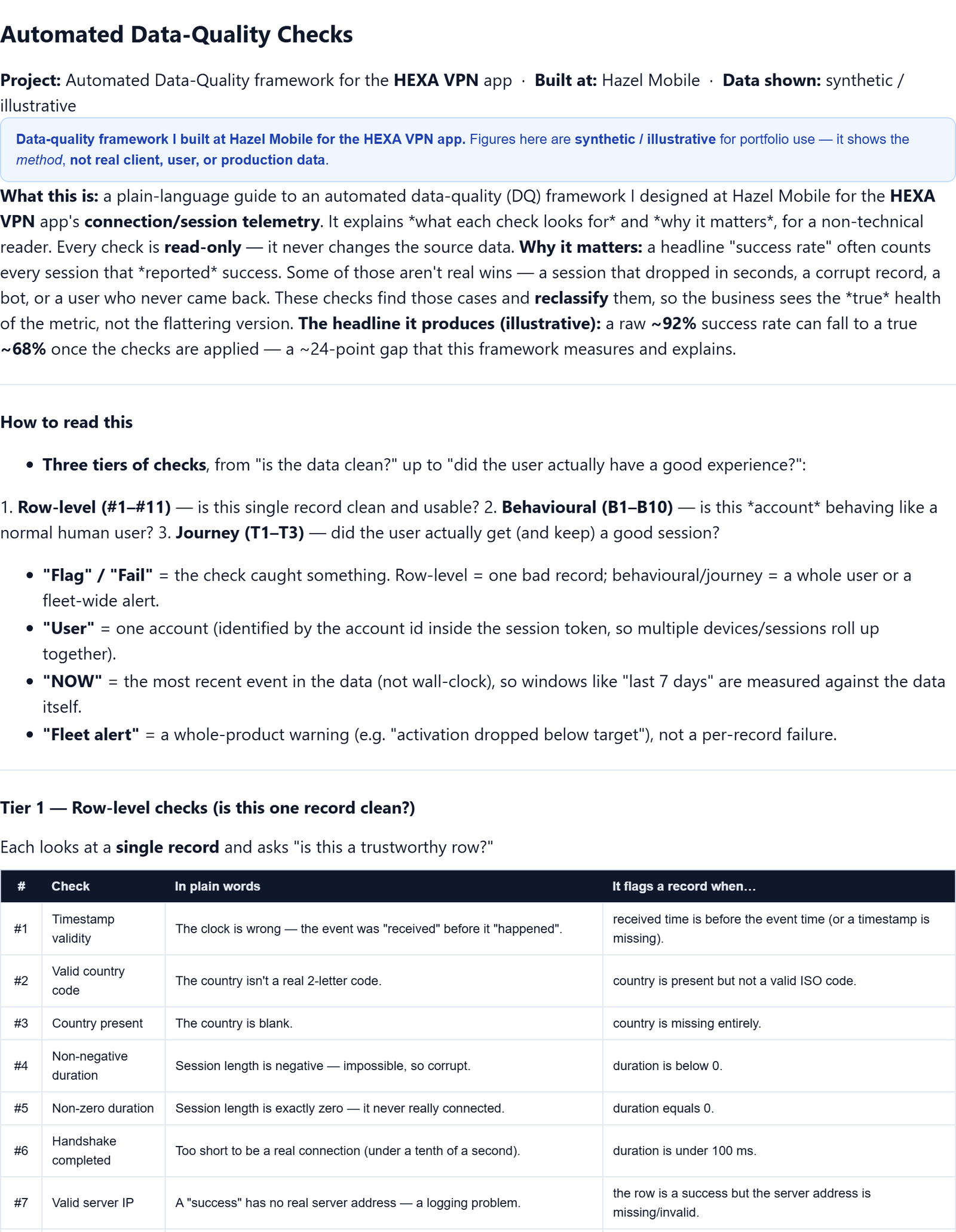
I designed an automated, read-only data-quality framework in SQL that scores the telemetry and reclassifies "fake" successes to failures — without ever deleting an event. It runs as three tiers of checks:
| Tier | Question it answers | Examples |
|---|---|---|
| Row-level (#1–#15) | Is each record clean, valid, and plausible? | timestamp validity, plausible session length, valid server IP, self-replace-bug, plus the data-integrity checks below |
| Behavioural (B1–B10) | Is each account behaving like a real user? | inactivity churn, bot/burst detection, one-and-done, country-hopping |
| Journey (T1–T3) | Did the user get (and keep) a good session? | flap (<30s), activation, next-day return, churn-risk |
The row-level tier runs fifteen checks (#1–#15) in one modular pass — from basic record hygiene (valid timestamps, plausible durations, well-formed server IPs, the self-replace-bug guard) through to data-integrity and degraded-experience signals:
- #12 · Implausibly long sessions — sessions running longer than three days (a duration-metering integrity signal).
- #13 · Future-dated timestamps — events that claim to have happened in the future (device clock-skew / impossible records).
- #14 · Free-user entitlement anomalies — free accounts carrying a day or more of accumulated connection time (a metering / granted-balance check).
- #15 · Fallback-route connections — sessions that only connected after switching to a backup route, i.e. a degraded connection rather than a clean first-attempt success.
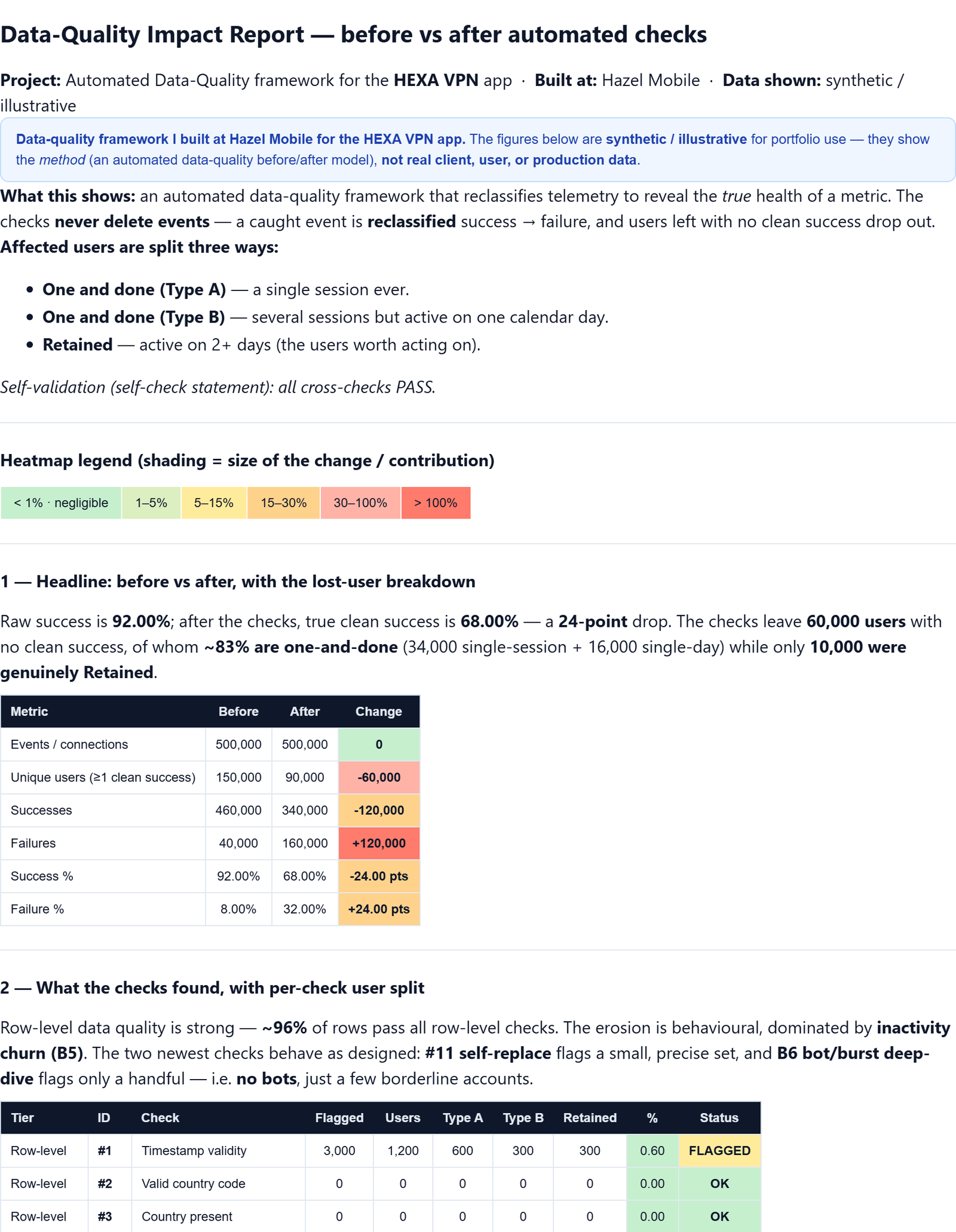
On top of the checks sits a before/after impact model: it computes the success rate as reported vs. the true rate after reclassification, splits the affected users into one-and-done vs. retained, and attributes the drop to individual checks. Attribution runs in priority order, so each check is credited only with the unique records it catches and the pieces always sum to the total.
The Techniques
The framework is a showcase of production-grade SQL:
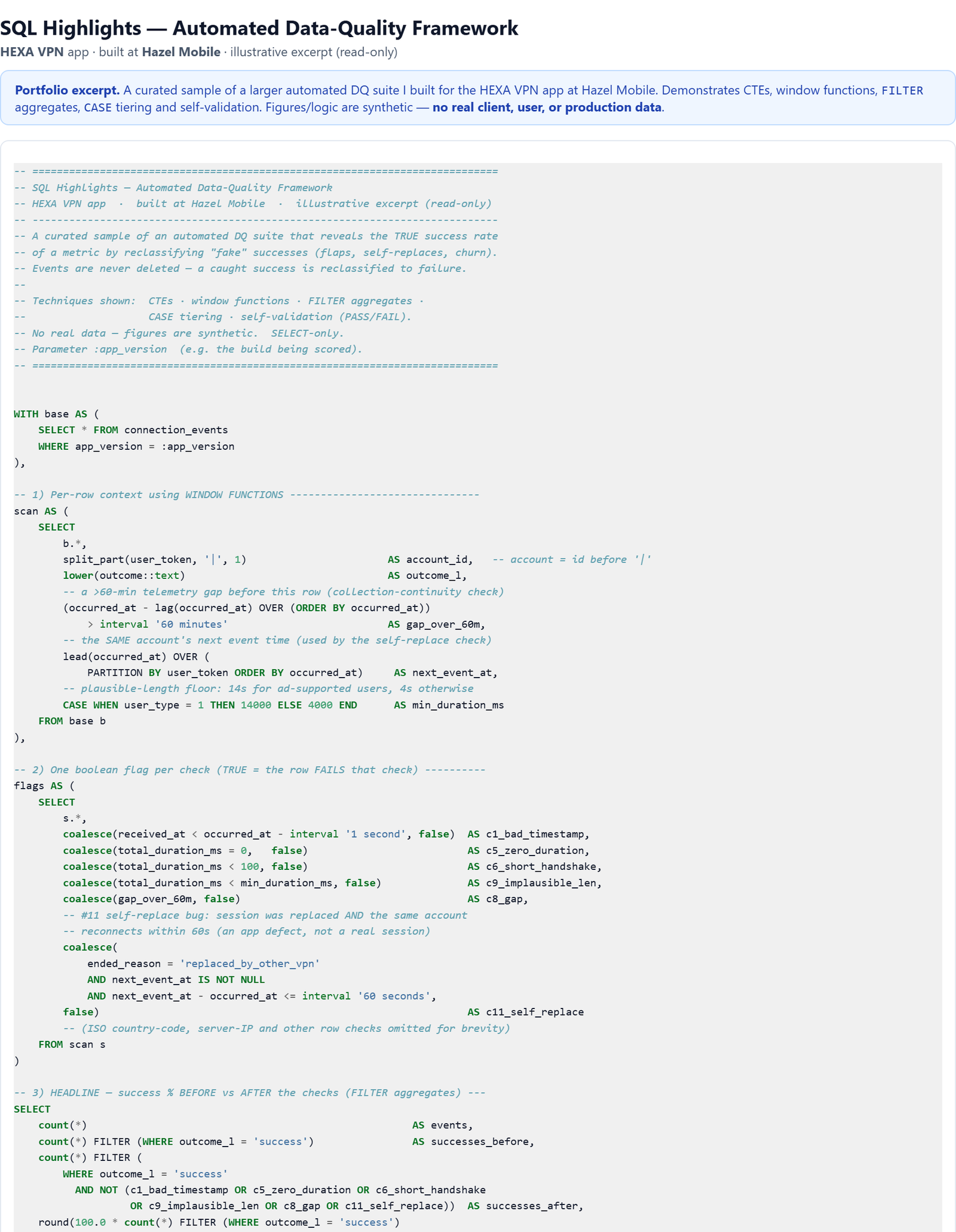
- CTEs to stage the logic in readable layers (scan → flags → aggregates).
- Window functions —
LAG()/LEAD() OVER (PARTITION BY … ORDER BY …)to detect telemetry gaps and the self-replace bug (a session replaced, then the same account reconnecting within 60 seconds). FILTERaggregates to compute before/after success in a single pass.CASEtiering for per-check status (OK / FLAGGED / ALERT) and tier-aware thresholds.- A built-in self-check that re-derives key totals a second, independent way and reports PASS/FAIL, so the numbers can be trusted.
Everything is SELECT-only and version-scoped, so it is safe to run against a live database.
The Impact
The framework surfaced a large gap between the reported and the true success rate (illustrative: ~92% reported → ~68% true) — and, just as importantly, explained it:
- The drop was churn, not corruption. Row-level data quality was strong; the erosion came almost entirely from inactivity churn (users who connected but never returned).
- The targeted checks added precision, not noise. The self-replace and bot/burst checks each flagged a small, well-targeted set — confirming there were no bots, only a few borderline accounts — without punishing real users.
- Most "lost" users had barely engaged (the large majority were one-and-done), so the business could focus on the genuinely retained users worth acting on.
What's in this case study
- Architecture diagram — how the framework flows from telemetry → checks → the reclassification model → the reports.
- DQ Impact Report (PDF) — the headline before/after tables and per-check attribution.
- DQ Checks Explained (PDF) — a plain-English guide to what every check does and why it matters.
- SQL Highlights (PDF + .sql) — a curated, syntax-highlighted excerpt of the actual query craft.
FILTER aggregates · CASE · subqueries) · data-quality engineering · data validation / self-checks · behavioural & churn analysis · analytical storytelling · stakeholder reporting.